We have developed a Secondary Insulation Layer Wall Solution, which enables the delivery of a 90mm timber frame wall, with a secondary insulation between 45mm thickness internal battens.

Hit enter to search or ESC to close
H1 Done.
We've got your insulation solutions covered
Changes to Building Code clause H1 bring the biggest energy efficiency improvements in over a decade. Comfortech® is well prepared to help you with these changes.
Research shows that damp, mouldy, poorly ventilated homes affect the respiratory health of many New Zealanders. To help address these issues, in 2022 MBIE introduced the new 5th edition of H1/AS1 and H1/VM1 for housing and H1/AS2 or H1/VM2 for buildings greater than 300 m². After further consultation and focus on balance these improvements while managing construction costs, in November of 2025 MBIE released the 6th Edition update of H1. These recent further changes have led to several positive developments in our product and service offering. Learn more about the H1 Building Code changes and our new solutions below.
New H1 Calculation Service
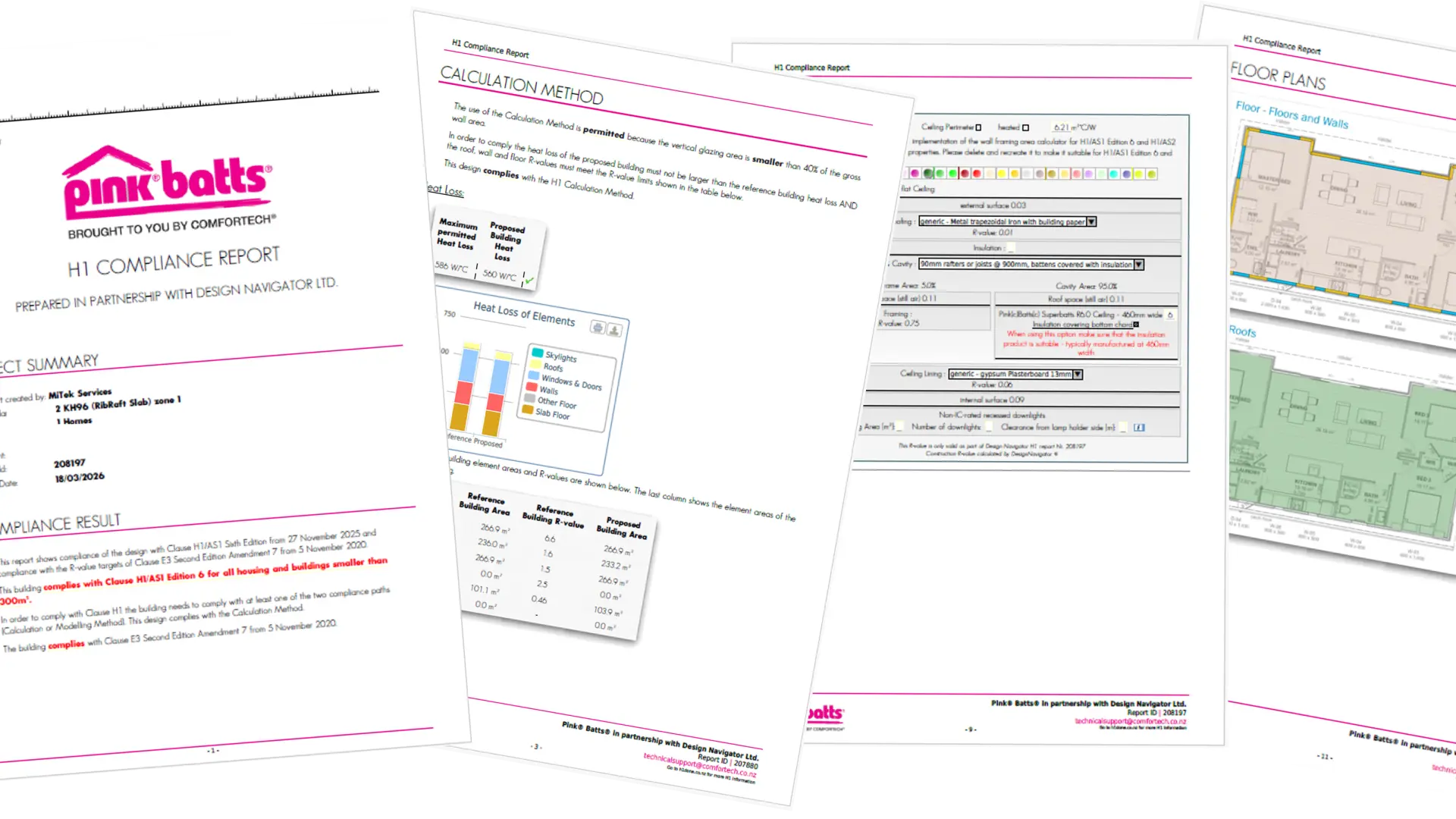
At Pink® Batts®, we pride ourselves on quality, service, and support. That is why we have partnered with the market leading H1 calculation service Design Navigator to offer a comprehensive H1 calculator, that addresses not only H1 but also E3. Our comprehensive H1 report has clear graphics that show the heat loss data broken down by element; being Skylights, Roof, Windows and Doors, Walls, and the Floor.
Like many things in life, you get what you pay for and if something is free it often comes at a cost down the line. That is why we have decided to charge a nominal fee of $150 plus GST for our comprehensive calculation report. With our turnaround time for a comprehensive H1 report is currently 1 week, depending on the clarity of the information provided and the degree of consultation required to achieve compliance.
Commentary from BRANZ on the changes to the 5th edition New Zealand Building Code energy efficiency clause H1 settings for residential buildings
A recent study completed by the Building Research Institute of New Zealand (BRANZ), titled “Technical analysis of New Zealand Building Code energy efficiency clause H1 settings for residential buildings”, had a number of findings regarding insulation levels, overheating and moisture in houses built to the latest NZ Building Code H1 thermal insulation legislation.
On insulation. overheating and moisture risks they concluded:
- Increased insulation in the walls, roof and windows will tend to decrease overheating risk during the day where most overheating occurs, as long as the house is being ventilated.
- Increased insulation levels in general tend to increase overheating risk overnight; comparable to or even greater than having no shading or having large windows, if a house is not adequately ventilated.
- Increased slab insulation may increase overheating risk due to reducing the effect of the thermal mass of the ground.
- If a house is not ventilated, it will likely see significant overheating that may be worsened by higher insulation levels, further exacerbated by high levels of airtightness in modern homes.
- While higher insulation levels can change the risk of moisture accumulation in walls and roofs, the values tested in this report do not suggest that the H1 5th edition insulation changes result in increased internal moisture risks.
- The key factors in terms of moisture risk were found to be the colour of the roof and wall claddings, indoor moisture loads and orientation of the construction.
The full paper, and the context on which the conclusions were formed, can be read here
Secondary Insulation Layer Wall Solution
Comfortech® H1 Residential Solutions
There is no one-size-fits-all solution for the new H1 Building Code changes, so our team has designed a range of residential solutions in partnership with the building industry that are flexible enough to cover a different building requirements.
Frequently Asked Questions - H1 Changes
What is the H1 Building Code 5th Edition?
In 2021, MBIE consulted on changes to Acceptable Solution H1/AS1, AS2 and AS3 and Verification Method H1/VM1, VM2 and VM3 to increase the minimum requirements for insulation in new homes and buildings.
The purpose of the H1 Energy Efficiency Building Code change is to reduce the amount of energy needed to heat new buildings (housing and buildings under 300m2) by up to 40%. These changes will provide warmer, drier, and healthier buildings in New Zealand, with less impact on the environment. For buildings over 300m2 the targeted reduction is 23% of energy use, for heating and cooling.
When did the 5th Edition H1 Building Code change come into place?
The H1 Energy Efficiency Building Code changes for residential and buildings under 300 m2 came into place on 01 May 2023.
MBIE is proceeding with changes to roof, window, wall, and underfloor insulation requirements, issuing the new H1/AS2 and H1/VM2 for large buildings, over 300m2 from 03 November 2022. This aims to reduce the energy needed for heating and cooling by 23% on average across large buildings over previous minimum status quo requirements.
What is an R-value?
An R-value is the thermal resistance rating used commonly in the building and construction industry to determine a materials ability to resit the transfer of heat.
What are Comfortech’s solutions to the H1 insulation changes?
The new Pink® Superbatts® insulation products are specifically designed to meet the new H1 requirements and are extra wide to bridge thermal gaps and maximise thermal performance.
Single-layer solution: For residential ceilings, a single layer of Pink® Superbatts® R7.0 at the width of 460mm can be installed. Pink® Superbatts® insulation products allow for friction fitting and ballooning to attain the required construction R-values
Double-layer solution: Comfortech’s two-layer solution uses a first layer of high-density Pink® Superbatts® insulation that is the combined height of the truss chord and the gap to the top of the ceiling batten. This layer would be 110mm for a 90mm truss chord and an R-value of R2.6 or 160mm for a 140mm truss chord and R3.0. The second layer is our new Pink® Superbatts®, over-width 460mm wide R4.5. Installed at right angles to the first layer, with this method, the thermal bridge is completely closed. A lower R-value second layer can be selected where another compliance pathway method has been chosen.
Can I install two layers of R3.6 insulation to meet the new code?
You can install a double-layer of R3.6 insulation. However, industry experts have expressed concerns that the second layer will compress the first layer, further reducing its R-value, and with the first layer sitting above the top of the truss chords, there is an open path for airflow over the joist, again reducing the thermal performance.
How do the H1 changes impact insulation installation?
The single-layer solution is the quicker of the two solutions to install, although it does require time onsite cutting. From trials with the PinkFit® insulation installation network, it will take 30% longer to install compared to the old R3.6 single layer and more of the product is required - as R-values have doubled. The double-layer solution involves further labour to install, likely twice that of a single-layer solution.
What are the benefits of the H1 Energy Efficiency changes?
- Increasing your house’s energy performance will help future proof your home and lead to energy savings over the life of the building.
- Reducing energy use from buildings will help Aotearoa New Zealand reach its goal of net zero carbon emissions by 2050.
- Using better performing windows and doors will reduce energy loss, improve comfort and help reduce condensation
- New insulation requirements will reduce the annual heating cost of new homes by up to 40%.
- Warmer, drier buildings will provide health benefits to occupants.
What is the Calculation method?
The calculation method uses heat loss calculations to determine the proposed building envelope R-value requirements and compares the results with the heat loss of a reference building.
Under H1/AS1 5th edition amendment 1, the calculation method can only be used where glazing is 40% or less of the total wall area. Its advantage over the schedule method is that it allows a building with different building elements to be assessed as a whole, with adjustments being made between elements. For example, a ceiling R-value may be reduced if the wall or floor R-value is increased to compensate or if window R-values are increased. In no situations may R-values for roofs or walls be reduced below the minimum R-values set down by E3/AS1. The construction R-value for roofs, walls and floors in the proposed building must be at least 50% of the construction R-value of the corresponding building element in the reference building (calculated via the Schedule Method). The calculation method cannot be used to reduce the performance of building elements that have embedded heating systems.
What is the Modelling method?
The modelling method gives designers the greatest flexibility around demonstrating compliance with the H1 Energy Efficiency changes. Modelling is used to demonstrate that energy use of the proposed building does not exceed the energy use of a reference building in the relevant climate zone.
What are the new climate zones boundaries?
The changes to climate zones will better reflect specific weather in different parts of New Zealand. The aim in making these changes is to make sure homes and buildings are more suited to the climate where they are being built.
There are six new climate zones, where the zones follow territorial authority (local government) boundaries to allow the insulation requirements to be easier to consistently administer and to better reflect the different climatic conditions experienced in each zone.
How does the H1 Building Code change apply to alteration projects?
Additions or extensions to a house involve both new construction and the alteration of an existing building. The new construction could be as small as cutting a window into an existing wall or could be as large as adding an entire storey to an existing build.
The new construction must meet the requirements of Clause H1, but the rest of the building does not have to be upgraded to comply with H1. The altered building must comply with Clause H1 to at least the same extent as it did before the alteration, and the overall energy efficiency of the building cannot be made worse by the alteration.
Are there new requirements for walls?
Under the 6th Edition of H1 MBIE have increased the assumed framing area to 38% and dropping the assumed construction R Value down from R2.0 to R1.6.
How does the H1 change impact heating?
There are several aspects of building thermal performance not addressed in the compliance pathway via the schedule method such as the shape of the building, size and orientation of windows, the risk of interstitial moisture, infiltration and ventilation heat losses, and the risk of overheating in the summer. The calculation and in particular the modelling method does go some way to address most of these.
With higher insulation R values, winter heating demand will be reduced. There is some risk in some scenarios, however that if a wholistic evaluation of the building throughout the year is not done (preferably via the modelling method) that summer cooling loads may in fact increase due to a more thermally efficient envelope retaining more heat. Therefore, window sizes and position as well as R values should be given careful consideration in this context.
Download our H1 overview
OUR
BRANDS